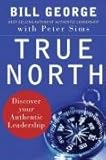
 I’m reading another great book right now. True North: Discover Your Authentic Leadership by Bill George. He is a professor of management practice at Harvard Business School and well-respected former corporate executive. Along with coauthor Peter Sims, he wrote a great book on leadership as a follow up to his first, Authentic Leadership.
Each chapter of True North is preceded by a set of leadership exercises. I thought it would be fun to post my answers here as I went through this book.
The first exercise helps you “think about the basis for your leadership and the process you need to go through to become an authentic leader.”
The True North exercises:
- Introduction Exercise
- Chapter 1: Your Story Exercise
- Chapter 2: Losing Your Way Exercise
- Chapter 3: Your Greatest Crucible Exercise
- Chapter 4: Knowing Your Authentic Self Exercise
- Chapter 5: Practicing Your Values and Principles Exercise
- Chapter 6: Your Motivations and Motivated Capabilities Exercise
- Chapter 7: Building Your Support Team Exercise
- Chapter 8: The Integrated Leader Exercise
- Chapter 9: The Purpose of My Leadership Exercise
- Chapter 10: Empowering Other Leaders Exercise
- Chapter 11: Honing Your Leadership Effectiveness Exercise
What leaders, past of present, do you admire most?
- What is it about them that you admire most?
- Which of these leaders do you consider to be authentic leaders?
- What can you learn from their leadership?
Damn. Those are tough questions. The leaders I admire are:
-
Jack Welsch – I admire the advances he’s made in the field of management and his dedication to the craft, as well as his desire to share that knowledge and encourage others to succeed, as evident in how often General Electric (GE) executives were sought after by other companies.
-
Warren Buffet – I admire his sensible & long-term thinking about the investment industry and his desire to give back & teach the community.
-
Bill Gates – I admire the fact that he was able to build one of the most powerful & impactful companies in the world, become the richest man in the world, then dedicate his life to humanitarian causes. Criticize him all you want, but his philantropic efforts have been enormous.
-
Joel Spolsky – I admire his dedication to his craft and the thought leadership he provides through his blog. It’s obvious he loves what he does and is always challenging himself and his company to do better.
-
Matt Mullenswag – I admire how he built a viable business on open-source software and attracted a huge community of developers & evangelists around something he personally cares deeply about.
To me, they are all authentic leaders. Looking at this list, I also notice that they all:
- love what they do
- believe in what they do
- give back to the community
Those core facets are what I admire most about them and what speaks “authenticity” to me. Hopefully I can emulate them and be half as good a leader as they are.
Thinking back over all your leadership experiences in your lifetime, which ones are you proudest of?
I was once the president of a cultural community service club in college. One of our activities was a street carnival that required a tremendous amount of work, especially for a busy college student with a double-major, two jobs, and officer responsibilties for a second club.
On the day of the carnival, I overslept, exhausted from my schedule. When I woke up in utter panic and rushed over to the street, I saw the carnival operating as scheduled. It was my job to meet the vendors and get them set up. So what happened?
My officers happened. They saw that I wasn’t there and stepped in to take over. At the time, I saw this as a failure of mine, but when I look back, I’m deeply proud of my team and what we did. The event also raised a lot of money for a church and their efforts to help the homeless.
During my time as an engineering manager at Yahoo! (YHOO), I had the pleasure of working with a large team of talented developers. There are dozens of seemingly small but important incidents that occurred over my time there.
For instance, there was the developer we considered a long-shot who floundered in his role for a while. Despite his performance, I always felt he was destined for more. I tried to give him as many opportunities as I could to shine in the form of side projects. One day, he was offered the perfect role for him by a team who had seen his side projects. He is now flourishing in that role.
There’s another developer who was a rock star, but didn’t realize it. Fortunately, neither did our competitors, with whom he was also interviewing. I was able to attract him to our company. I wasn’t even hiring for my team; I just knew he’d kick ass and wanted him in the company somehow. And he has definitely kicked ass.
Then there was the developer who didn’t have the solid experience we needed, but had an extra quality that intrigued me. Since hiring him, he’s risen to one of the top developers in the company. People try to woo him all the time now.
I wish I could go on – the developer who had the aptitude and eagerness to be a leader herself, and with some training, is now leading an important project; the developer who flailed nervously in his first role, then left to start his own successful company; and the developer who wanted to learn a different role and with some encouragement, training, and the right opportunities, has made it there. All of these are moments that fill me with pride whenever I think about them. I’m smiling right now as I type this.
Think about the basis for your leadership and the kind of leader you would like to be as you answer these questions:
- What qualities do you bring to leadership?
- What leadership qualities would you like to develop further?
My leadership style is that of a teacher. One of my former developers even called me his therapist and our one-on-one meetings as his therapy sessions.
I also regard myself as someone who is able to identify talent and harness it, through encouragement, reframing, training, discipline, and proper positioning. Wearing this hat, I told my team I was their agent and they, my rock stars.
While that’s great and all as a people manager, what I need to build now are my business management skills. Although I believe being good in business is largely a product of one’s knowledge of psychology (dealing with employees, customers, vendors, and other stakeholders is an interpersonal art), the ability to read a company’s key metrics is important in determining its financial & operational health.
Although I’ve always believed that I could hire someone who is smarter than me to do that, I feel I should also have that skill to some extent.
Asses yourself against the five dimensions of an authentic leader:
- Do you understand your purpose?
- Do you practice your values?
- Do you lead with your heart?
- Do you demonstrate self-discipline?
I understand that the search for a purpose can be a long, philosophical, and even spiritual journey for many people. For me, I believe a person can also choose their own purpose. I’ve already chosen mine – to improve our society fundamentally through education. The road is tough and I have a long way to go, though I’m thankfully not alone.
Everyday, I apply my values to my life. I believe that being a parent is one of the most difficult, important, and rewarding roles a person could ever play. To be a good parent, I need to be a good role model. To be a good role model, I need to live my life with honor, compassion, understanding, adaptability, discipline, and values.
Although I tend to be a cerebral thinker who decisively weighs all alternatives, if I don’t believe in an organization or goal, I cannot work in or towards it to my full extent.
Back to being a good parent, the overall sentiment is one of self-improvement. Self-kaizen, so to speak. Included in such a personal journey is constant self-discipline, the pillar for a strong mind and strong body. I don’t believe you could be an effective parent, or business owner, without self-discipline.
Do you feel that you are more effective as a leader when you are authentic, or does being authentic constrain your leadership effectiveness?
Being authentic is vastly more effective. If you are true to yourself, you’ll be able to lead with your most effective skills & talents, therefore making you a more effective leader.
Are you consciously developing your leadership abilities at this time?
I’m developing my leadership skills (as a business owner, father, etc) all the time. Also, I’m reading this book, aren’t I? Wink wink.
How would you answer these questions?
The True North exercises:
- Introduction Exercise
- Chapter 1: Your Story Exercise
- Chapter 2: Losing Your Way Exercise
- Chapter 3: Your Greatest Crucible Exercise
- Chapter 4: Knowing Your Authentic Self Exercise
- Chapter 5: Practicing Your Values and Principles Exercise
- Chapter 6: Your Motivations and Motivated Capabilities Exercise
- Chapter 7: Building Your Support Team Exercise
- Chapter 8: The Integrated Leader Exercise
- Chapter 9: The Purpose of My Leadership Exercise
- Chapter 10: Empowering Other Leaders Exercise
- Chapter 11: Honing Your Leadership Effectiveness Exercise


 I’m jealous of the students at Kansas State University.